Technology
Light the grass can use, at an intensity it can process.
Turf does not respond to brightness. It responds to photons between 400 and 700 nm, arriving at a rate it can convert, accumulated over a day, in a spectrum that does not read as shade. A rig that gets any one of those four wrong wastes electricity.
The measurements
Four numbers describe any grow light honestly.
PAR, 400 to 700 nm
Photosynthetically active radiation. The waveband plants use to fix carbon. Lumens and watts describe neither the plant response nor the cost of producing it.
PPFD, µmol/m²/s
The rate photons arrive at the canopy. Every EnovaLight rig holds 400 to 450 across its rated area. A bright midsummer noon is around 1,900.
DLI, mol/m²/day
PPFD accumulated over 24 hours. This is what determines whether grass holds density. A summer day outdoors delivers around 50. A shaded winter pitch has been measured at 7.1.
Efficacy, µmol/J
Photons produced per joule consumed. The only figure that says what the light costs. Current LED sits near 3.5, double-ended sodium near 2.1, older mogul-base sodium near 1.0.
The deficit
A shaded pitch in winter runs at roughly a third of what the grass needs.
Published thresholds for the species used on professional surfaces sit in the low twenties. A French field study measured the shaded condition of a stadium pitch through the winter of 2019 to 2020 at 7.1 mol/m²/day. Supplementary lighting lifted it to around 12. The gap between those two rows is the reason grow rigs exist.
| Species or condition | Daily light integral | Source |
|---|---|---|
| Perennial ryegrass, optimum quality | around 23 mol/m²/day | US field research |
| Perennial ryegrass, survival floor | about 10 mol/m²/dayrecovery limited under high use | US field research |
| Conventional Kentucky bluegrass | 22 to 26 mol/m²/day | Reed et al., Crop Science, 2024 |
| Bermudagrass, mown at 1 inch or higher | 20 to 25 mol/m²/day | Bermudagrass shade trials |
| Stadium pitch, shaded, winter 2019 to 2020 | 7.1 mol/m²/day | Abélard, ITSRJ, 2022 |
| Same pitch with supplementary LED | 12.0 mol/m²/day | Abélard, ITSRJ, 2022 |
Intensity
Why 450 and not 900.
The most common mistake in turf lighting is buying intensity instead of daily light. Photosynthesis rises with PPFD only until the leaf saturates, after which additional photons are dissipated as heat and paid for in full.
150 µmol/m²/s
The light compensation point for perennial ryegrass. Below this the plant respires more than it fixes and the surface goes backwards, however long the rig runs.
400 to 450 µmol/m²/s
Where EnovaLight rigs operate. Well clear of the compensation point and inside the efficient part of the response curve, where each additional photon still converts.
867 µmol/m²/s
The reported saturation point for the same species. Approaching it roughly doubles the electrical draw for a much smaller gain in carbon fixed.
Duration is the cheaper variable
DLI is PPFD multiplied by time. Ten hours at 450 delivers 16.2 mol/m². Five hours at 900 delivers the same 16.2 for the same total energy, but every one of those photons arrives closer to saturation, so fewer of them are converted. For cool-season turf, which reaches saturation at around half of full sunlight, running longer at a moderate intensity returns more grass per kilowatt-hour than running briefly at a high one.
Spectrum
Grass reads light as information as well as energy.
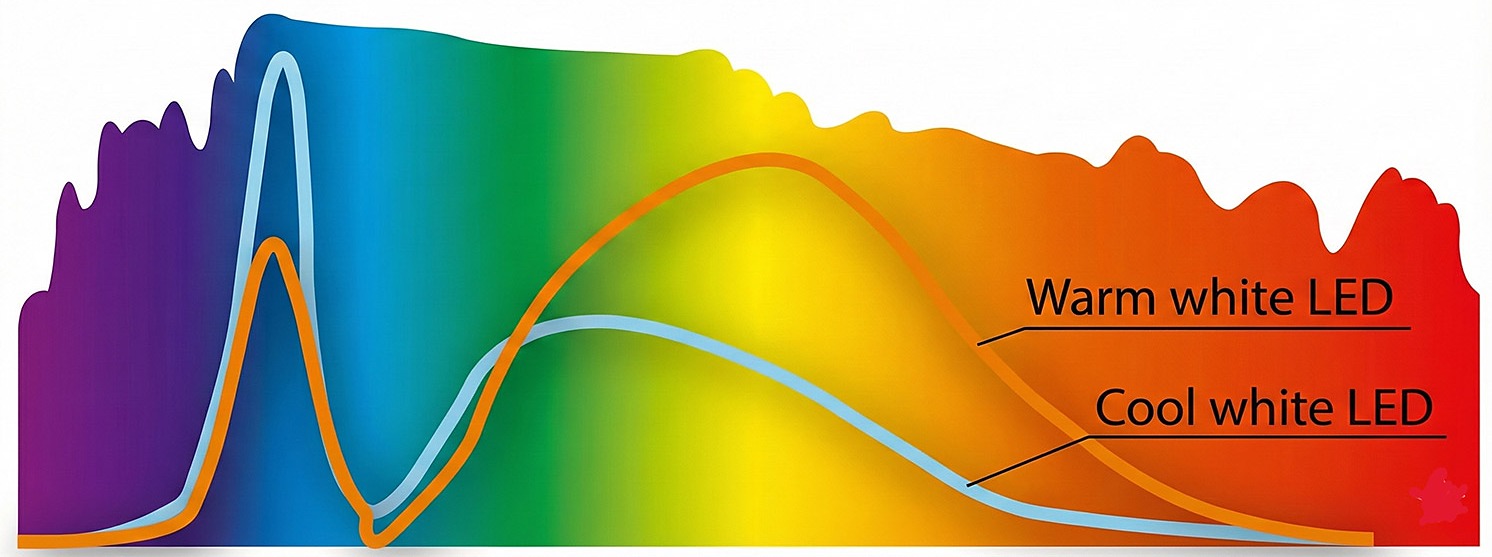
Intensity drives photosynthesis. Ratio drives morphology, through phytochrome and cryptochrome. A canopy under vegetative shade receives light depleted in red and enriched in far red, and the plant acts on that ratio before it acts on the shortage itself.
Red and far red
A low red to far red ratio is the signal a plant reads as competition. It reduces tillering, elongates leaves, thins them and lowers chlorophyll content. On a sports surface, tiller density is wear tolerance, so triggering a shade response while lighting a shaded pitch defeats the purpose of the treatment.
Blue
Blue drives stomatal opening through cryptochrome and holds leaves short and thick. It is kept in the mix rather than minimised. Ryegrass trials comparing cool white against 90 percent red with 10 percent blue found the red-dominant recipe gave the worst photosynthetic performance of those tested.
White, and the green inside it
Chlorophyll absorbs red and blue so strongly that they are spent in the top layer of the sward. Green passes further: measurements through a canopy found under 0.5 percent of blue and 2.1 percent of red reaching the base, against up to 6.5 percent of green. In a dense mown turf that lower canopy is most of the leaf area, which is why a white-based spectrum outperforms a red and blue one here.
Distribution
An even footprint matters as much as a bright one.
An LED package without secondary optics has a beam angle around 120 degrees. Output falls to roughly 80 percent at 30 degrees off centre and around 40 percent at 60 degrees. Left uncorrected, a rig delivers its rated figure directly beneath itself and a fraction of it at the edges, and the grass grows at the rate the light varies.
Compare like for like
Two rigs quoting the same average can differ substantially at the edges. The figure that predicts uniform growth is the ratio of minimum to average across the treated area.
No radiant heat load
LEDs do not put the infrared onto the canopy that discharge lamps do, so a rig can sit over grass for a full treatment without scorching it.
Fixture life
LED fixtures in this class are rated in the region of 50,000 hours. High-pressure sodium lamps are typically rated near 16,000 and lose output well before failure.
Limits
What light cannot fix.
A surface grows at the rate of whatever is scarcest. Adding light to a pitch that is short of something else buys nothing, and we would rather say so before a rig is on site than after.
Temperature
Carbon fixation slows with soil and air temperature regardless of light. This is the honest trade against sodium: those lamps warmed the canopy as a side effect of being inefficient, and LEDs do not. On a cold pitch, undersoil heating or covers do more than extra lamp hours.
Water, nutrition and gas exchange
Light raises demand for everything else. A treatment on a compacted or underfed rootzone produces top growth without root development, which is the opposite of wear tolerance.
Wear that outruns recovery
No lighting programme outpaces a surface taking more events than it can regrow between. Lighting shortens the recovery window. It does not remove the need for one.
Measure first
How to get the number we will ask you for.
Everything above turns on one figure, the daily light integral in the areas that lose grass. It takes a quantum sensor and a week.
Use a PAR sensor at canopy height
A quantum sensor reading µmol/m²/s. A lux meter measures what the eye sees, which is not what the plant uses.
Log, do not spot check
Record continuously across 24 hours and integrate. A midday reading in a stadium bowl tells you almost nothing about the day.
Take a shaded zone and an open reference
The difference between the worst area and an unobstructed one is the deficit a rig has to close.
Measure in the darkest weeks
Late December through February in most northern venues. Sizing on an October reading undersizes the fleet.
Treatment hours
Closing the gap is arithmetic.
A rig adds daily light at a known rate, PPFD multiplied by run time. Enter what your pitch receives and the level you want.
Figures are at the canopy, across the rated area, and assume light is the limiting factor.
Sizing
Send us your light readings.
If you have PPFD or DLI data for the shaded areas of your pitch, we will work out which rig closes the gap and how many hours it takes. If you do not, we will tell you what to measure and lend you a sensor.
Sources
- Abélard, E. The effects of artificial lighting on sports turf. International Turfgrass Society Research Journal, 2022.
- Reed, et al. Minimal light requirements of Kentucky bluegrass under reduced photosynthetic photon flux. Crop Science, 2024.
- Different LED light intensity and quality change perennial ryegrass physiological and growth responses, 2023.
- Bell, Danneberger and McMahon. Spectral irradiance available for turfgrass growth in sun and shade. Crop Science, 2000. Compensation and saturation points for perennial ryegrass.
- Kasperbauer, 1971, on transmission of blue, red, green and far red through a canopy.
- University of Minnesota Turfgrass Science, on red to far red ratio and turf quality.