Mobile LED grow rigs for natural turf
Grass needs 23 mol of light a day. A shaded pitch gets 7.
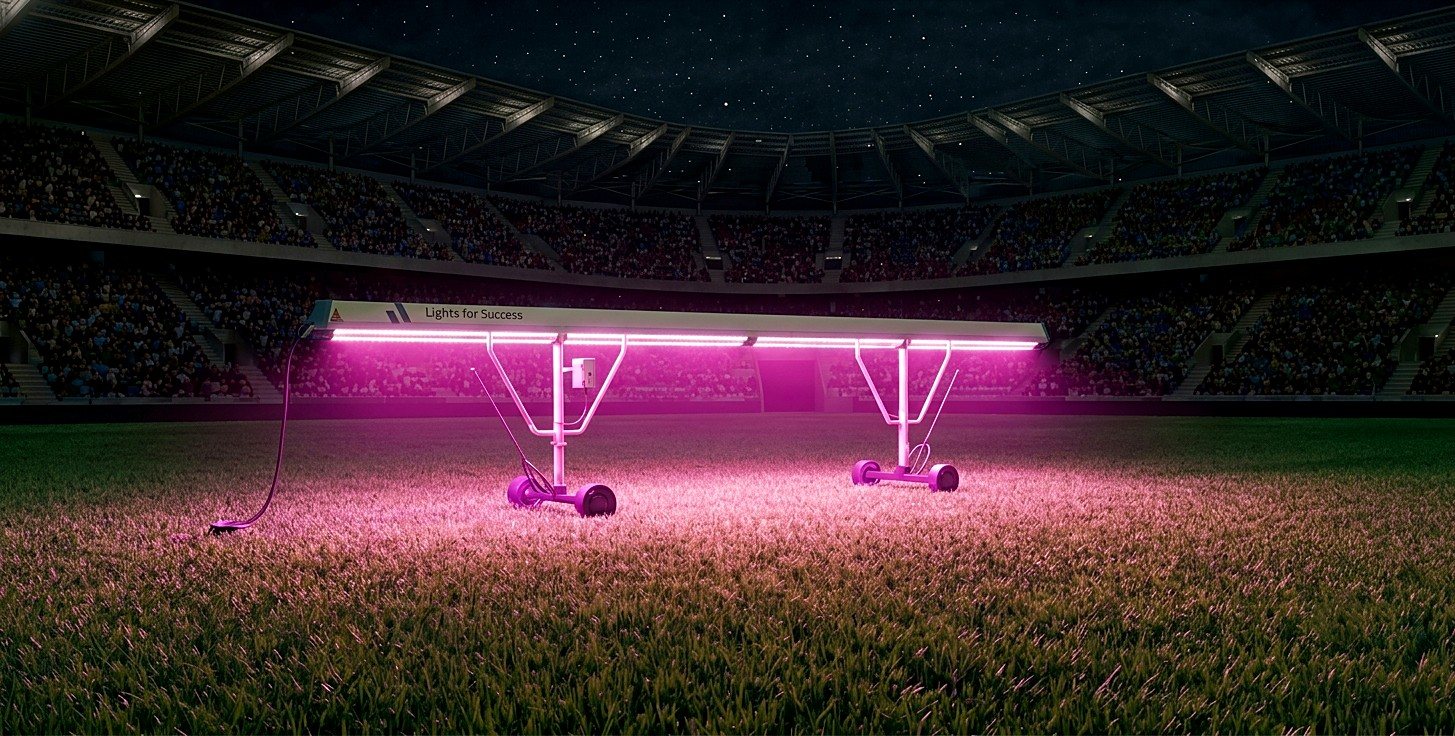
EnovaLight builds mobile LED grow rigs that put the difference back, zone by zone. Five sizes covering 100 to 1,300 square feet at 400 to 450 µmol/m²/s, the intensity at which perennial ryegrass peaks.
The problem
A light deficit does not stay a light problem.
Perennial ryegrass holds optimum quality at a daily light integral around 23 mol/m². A stadium pitch in shade through winter has been measured at 7.1. Roofs, high stands and low sun angles take the difference, and match and concert loading removes more grass than the surface can replace. By the time it is visible from the touchline it is already expensive.
The surface thins before the season ends
Density falls first in the goalmouths, the centre circle and under the stage footprint. Those are the areas that carry the most traffic and get the least light.
Re-sodding is the heaviest fix there is
Houston moved roughly 81,000 square feet of grass from Colorado in 25 refrigerated trucks for a single tournament. A partial re-sod mid-season takes the pitch out of use and costs a season's lighting budget in one week.
Events land on a marginal surface
Footing, ball behaviour and broadcast appearance all follow density. A thin surface is a player safety conversation before it is an agronomy one.
What we do about it
Measure the deficit, light the zone, move on.
Treatment is targeted rather than blanket. A rig covers the area that has lost light, for the hours needed to close the gap, and the grounds team keeps working around it.
1. Find the deficit
Measure the daily light integral in the shaded and worn areas, and compare it against what the species needs.
2. Match the rig to the area
Five sizes from 100 to 1,300 square feet, so a goalmouth does not get lit with a rig built for a stage footprint.
3. Run the hours needed
Deficit divided by delivered light gives the run time. Sensors adjust output through the treatment.
The range
Five rigs, one light recipe.
Every rig runs the same four-channel spectrum. What changes is the area it covers and the power it draws, so a venue can match rig size to the area that actually needs treatment.
The alternatives
Four ways a venue deals with a shaded pitch.
Energy figures compare an EnovaLight 24 against a sodium rig delivering the same light to the same 650 square feet.
| Approach | Closes the deficit | Draw for the same light | Pitch availability | Record kept |
|---|---|---|---|---|
| Accept the shade | No | None | Falls with density | None |
| Re-sod the worn areas | No, the deficit returns | Freight and labour | Out of use for the work | None |
| High-pressure sodium rigs | Yes | 12.9 kW | Rig on the pitch | Manual |
| EnovaLight rigs | Yes | 7.8 kW40 percent less | Rig on the pitch | Logged in EnovaTurf |
Why EnovaLight
Three things that decide this purchase.
The intensity is not a marketing number
Perennial ryegrass tested at 200, 300 and 400 µmol/m²/s gave its highest photosynthetic rate, pigment concentration and biomass at 400. Every rig runs at or above that.
Five sizes, so you light what needs it
A single large rig treats one area at a time. A range from 100 to 1,300 square feet lets a venue run three small treatments in a week rather than one large one.
Engineered, not assembled
EnovaLight is an EnovaWorks product, out of the same mechanical, electronics and software practice that develops equipment for offshore, industrial and medical clients.
EnovaTurf
The software that runs the rigs and keeps the record.
A treatment happens, the rig moves on, and the evidence usually goes with it. EnovaTurf logs rig hours and delivered light against sensor readings and aerial survey, zone by zone, so a grounds team can see what worked and decide what to treat next.
Rigs
Hours run, energy drawn and light delivered, by zone.
Sensors
Canopy light, soil and air conditions, logged continuously.
Aerial survey
Drone passes turned into a grass health map of the surface.
Get started
Send us your light readings.
If you have daily light integral or PPFD figures for the shaded areas of your pitch, we will tell you which rig closes the gap and how many hours it takes. If you do not have them, we will tell you what to measure and how.